It’s a scary mathematical world out there! Hmm… really?

Math, math, math, what are your thoughts on this subject?

maths from Flickr via Wylio
© 2011 Sean MacEntee, Flickr | CC-BY | via Wylio

Is it true that math is portrayed as a hard subject? As a student have you ever received the message that  some people are math people and others are not?

Do we hold stereotypical messages about gender or race and ability to do math?

When you were in school what did you think about your own ability to do math?

You might be surprised to hear:

“All students can achieve at the highest levels in maths at all levels of school right up to the end of high school.”

Yes, there are countries in the world where this is the expected norm.

This summer I am using this blog to reflect on my learning in the course: How To Learn Math by Jo Boaler. This course is intended for teachers and parents and presents new research ideas on learning, the brain, and math that can change the way you think about math and how we learn.

The ideas on this blog will be a combination of my reflections and notes from the course.  My hope is that along the way I’ll add clarity, and a deeper understanding to what I already know about math instruction and gain new ideas on how enlarge and enrich the world of math for my students. I hope you’ll join me in this adventure.


An Online Math Course verses Summer Reading

This summer I am taking an online math course from Jo Boaler, Professor of Mathematics Education, Stanford University.

It is fitting I think, that an online math teacher should take an online math course and it is logical then, that one of my interests is the very structure and organization of the course. How do I as a student interact with the course and with other students?  In what way is this course engaging? How do I assess my progress?  Does the course provide resources for further learning? And how on earth can an online course compete with summer in Alberta?

Summer reads verses online math courses, its a tough competition.

It must be engaging, and you may be happy to know it is, both in content and structure, because for a period of time each day I am passing up on warm sunshine and relaxing beach reading, to sit in front of my computer.

What are the features of this course that make it work for me? Each lesson consists of a series of  short videos with accompanying text.  I can view the videos several times if I wish and stop at any point to jot notes. The videos are short, from less then a minute to about 12 minutes and each video ends with a question that asks a response from me. In addition each video includes a forum where participants can reflect and comment on content. As a whole the course is easy to navigate, I can see my progress and understand what is next.

Already I can see these strengths:

– short chunks for learning

– immediate opportunity for response to the content

–  interaction with other students

– flexibility to work through the material in any order.

– easy to navigate

– learn when I want ( and enjoy the sunshine too!)

Have you ever taken an online course?  How was it structured? Did the course format work for you? What worked well?  What would have improved the course for you?  I would like to hear about it.

English Language Learners in the Czech Republic

As I look back to the summer of 2013, countless memories remain from my experience as an English language teacher in the Czech Republic.

The beauty of Prague? Yes surely.
The challenge of daily communication? That too.
The warmth of people in the Czech Republic ? Absolutely!

All this and more….

What a crew we were, several accomplished ELL instructors and a group of enthusiastic, willing, professionals prepared to share part of their summer with English Language Learners in the Czech Republic. We were motivated by faith, striving in a meaningful way to share the life of faith in Christ, by leading a week long English Camp.

English Camp

Could all the hours of preparation prepare us for the unknowns our team might experience as we conducted our week long English camp? Hmmmmm….. likely not.

Lessons for several levels of learners had been prepared with care, daily welcome and ice breaker activities were ready to go, evening programs to close the day with energy and good spirits were included in our arsenal of plans.

In the Czech Republic, students age 12 to 25 and several adults aged 55 and 75 had set aside a week of daily life to be learners. They were an eclectic and amazing bunch, from all walks of life. Our classes included adults who had experienced the Russian occupation and young people who were eager for a new future. As I think of them now, a year later, they were role models of students eager to learn.  They were persistent, willing to learn from mistakes, and encouraged by each other’s success.

As a teacher I was happily immersed in the joy of learning for one short week with these lovely people.   These students demonstrated that ability and ‘smartness’, grows with experience.  These English language learners had a growth mindset when it came to developing new skills.

Learning involves risk taking and all of us, teachers and students, had to be willing to jump in and try something new. Each of us would evaluate our attempts at communication, revise, laugh to ourselves and forge ahead. How I applaud these students, who were willing to take the plunge. Sometimes it was with shyly spoken words and other times with full expression in a reader’s theatre.

Shared meals and conversation developed a learning community, as we laughed, cheered, problem solved, and persisted to share stories about ourselves. How could I forget, warm and gentle Pavell who came to learn this year because he heard about the class from others. Or wise and kindly George who approached my husband, Sid, on our last day, put his hand on his own heart, then reached out and put his hand on Sid’s heart, as he quietly said, “We are brothers. ” We reached beyond language barriers to truly communicate.

Our work was built on careful organization by our host church , First Baptist Church of Litomaurice. Every last detail, food, lodging, teaching facilities, and student registration was carefully thought out and arranged. How thankful we were for the love, care and commitment that went into this preparation.

We made connections across the globe and as I reflect on last summer I see no distinction between learners and teachers, we all came away changed.

Developing Lifelong Readers – Where to begin?

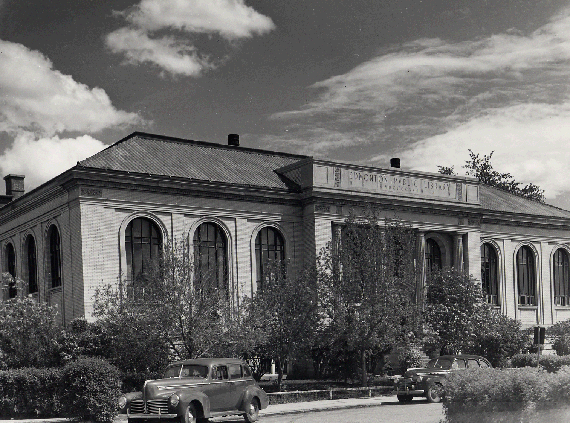
I held my father’s large, calloused hand and matched his stride as we walked up the steps to the library and through the heavy wooden doors.  We stood in the foyer, one long staircase before me led down to the children’s library and the other,  up to the distant unreachable land of adult books.  Perhaps someday I might venture there too.

After pausing, with some cautious uncertainty I slowly made my way down the stairs and opened the doors at the bottom.  What wonder and delight filled my young heart as I stepped through those doors!  In an instant I fell in love with books and reading. Books everywhere… colorful and inviting.  Perhaps it was at that moment that the reader in me was born.

The memory of sharing that Saturday afternoon with my father is fixed in my brain and when the Edmonton Public Library and  Vintage Edmonton displayed this image online it brought a smile.  Good things have small beginnings.

Edmonton Public Library - Central Library 1923 to 1966
Edmonton Public Library – Central Library 1923 to 1966

This building was my happy introduction to libraries and the wonders they contain.

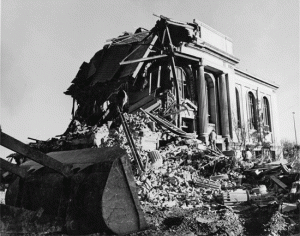
Library Demolished 1966

It demolished in 1966, to make way for more modern architecture.

That which remains is the happy heart of a lifelong reader.